Hello Theo! Thank you for being here with us today. First, can you tell us something about yourself and your background?
I was born in St. Petersburg, Russia. I studied at University in Moscow which is considered one of the best technical universities in Russia. I first studied physics, but I was particularly interested in computational neuroscience which is the study of the brain and its functions. However, at that time there was no such a major so I could either pick biology which would mean doing experiments on mice – which I find really creepy – or focus more on the computational part. So, from physics, I switched to computer science. Then, I wrote my master thesis on the topic of deep learning, not deep learning of the human brain but deep learning and its real-life applications. I focused on parsing road scenes imagery - so basically you can imagine as I was teaching the car to recognize what it sees - these are the traffic lights, this is the pedestrian area, this is a crossing, etc. After this, I started working for one of the biggest IT companies in Russia, Yandex where I worked as a software engineer. After some time there, me and five other engineers took the lead on a self-driving car project. The company gave us financing, we bought used cars, and started developing and building an autonomous car.
Was this when you discovered your passion for robotics?
Yes, exactly. It was a lot of fun. My day looked like this: In the morning, I would go to a garage which was my office. There was a used Toyota Prius that we were retrofitting. We added sensors, cameras, and all the cool stuff. We were collecting data; I was playing with the artificial neural networks. I loved it. And I would go the extra mile, stayed overnight at the office; I was fully committed. Until we eventually did build a self-driving car.
And I would go the extra mile, stayed overnight at the office; I was fully committed.
Why did you decide to leave?
At some point, our team was counting fifty people, and I looked around and figured out that so much has changed since I started the project. And it was not for me, so I decided to leave the company. My friends and colleagues did not understand why I quit - I had a comfortable job, I was doing something innovative which I always wanted, we had a great team and I had friends there. But I think about it like an optimization. Imagine a minimum of some function, and you are following the gradient and you are going down and you are at your local minimum, and it feels good. But maybe there is a deeper minimum somewhere, and you need to go uphill to find out what else is out there waiting for you. I felt this urge to find that out, and I knew there was a lot of uncertainty, but life is unpredictable and sometimes you need to take risks.
Life is unpredictable and sometimes you need to take risks.
So, I left and started working for a start-up developing computer vision for quality assessment for meat producers. I became a CTO, but eventually, I realized it was something I did not want to be part of. I left the company and became a vegetarian. I then joined other start-ups in the autonomous driving industry which eventually got acquired by DoorDash.
Why now is a good time to found your own start-up?
I was always thinking about starting my own business, and some of my classmates did that straight after university, but I felt I was not ready yet and the timing was not right. After I left Russia, I was working for a start-up that had a 3 billion valuation at one point, but now is struggling to survive. But at that time, I learned a lot about how to raise money, how to spend it wisely, and how to build teams. I saw it all from the inside. I have gained some experience over time and accumulated knowledge that I feel I can capitalize on now. I am not a kid anymore; I feel more confident and bolder. I believe that founders should be bold and brave because it is not always easy, most of the time it will be hard.
I believe that founders should be bold and brave because it is not always easy, most of the time it will be hard.
Why did you choose to build your company with Antler?
When I decided I was in a good position to found my own business, I started looking for someone or something to support me on the way. And a friend of mine Daria was with Antler at that time, and she was telling me about what exactly she is doing, how it works – that you get financial support, but also mentorship, guidance, access to a huge network of experts, founders, and really incredible people. In the end, you can get funding for your own start-up. So, I weighed my options, and here I am.
What has been the biggest challenge so far?
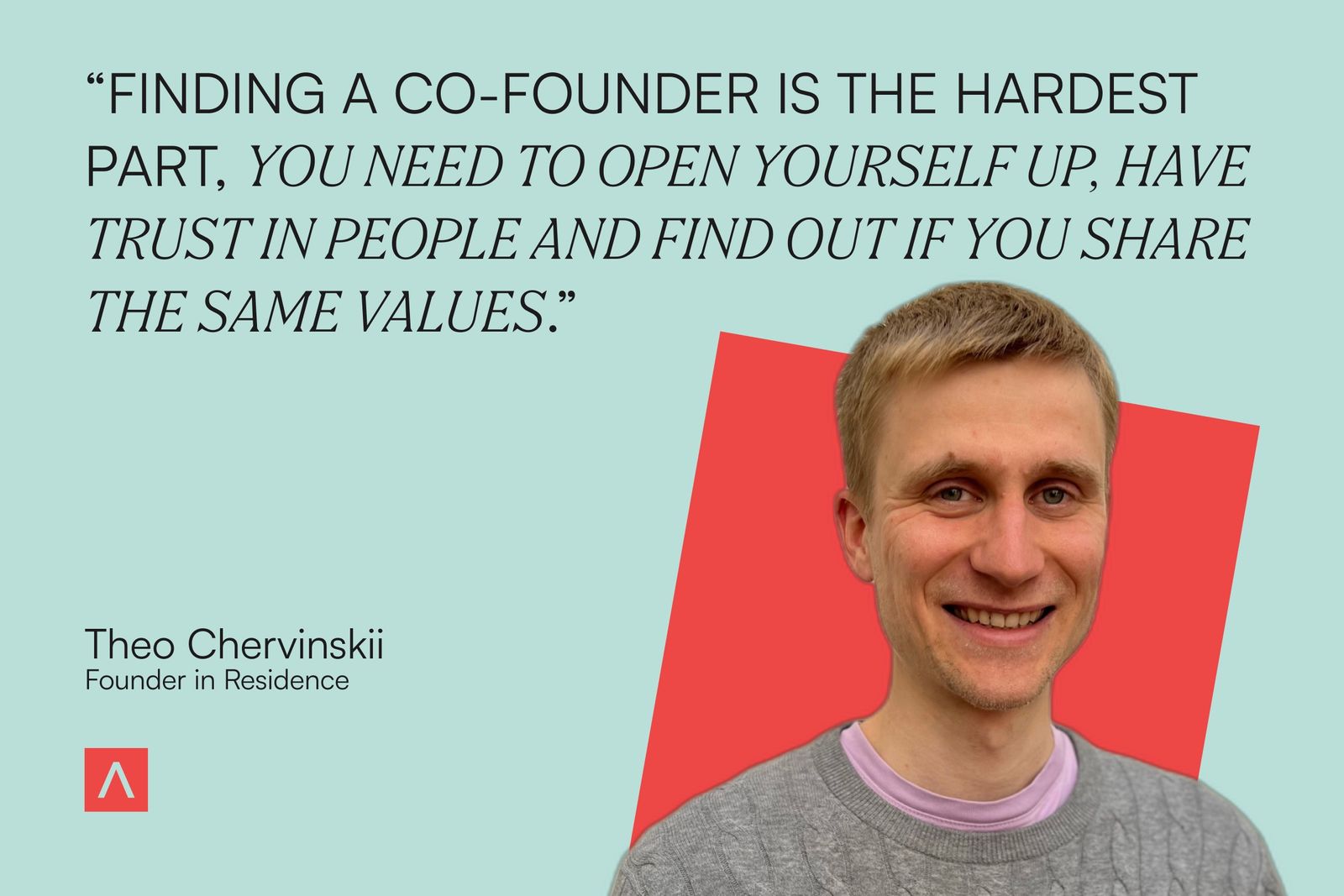
For me, finding the right founder is probably the most difficult part – it is kind of a social experiment. You really need to open yourself up, talk to people, and get close to them to understand if you share the same values and goals. If they have the necessary drive, and if you two are a good fit. But at the same time, there is a limited amount of time and sometimes you just need to take a risk and see if it works out, because it is better if you fall apart now than before you have started building something with funding. It can be a little stressful sometimes but you just need to get yourself out in the open and have trust in people.
Do you have any tips for other founders?
As I mentioned, things can be tense, and you need to find a way to relax. Some people exercise, some people eat, and some watch Netflix. For me, it is running. So, when I am stressed out, I run that stress out, I run my ten kilometers, I clear my head, get a step back from whatever was bothering me and come back to a very different place, with new ideas and different perspectives. What I am trying to say is to find your way to release stress, it is very individual so find what helps you most. At the same time, however, you need to be able to notice that you are stressed and that it is maybe time to take a step back. Allocate some time for yourself, networking is important in this industry but so is your mental health.
Do you have any recommendations for a book, podcast, or anything that would inspire future founders?
There is this one book called Build – The Unorthodox Guide of Making things worth making by Tony Fadell, the creator of the iPhone. There are many great books on how to build a company but this one really resonates with me because the author was also an engineer. And the way he explains everything - all about sales, marketing or anything that is not tech-related feels really close to me and makes much more sense to me when it comes from an engineer.
To find the people and funding you need to build a world-changing company,apply to an Antler residency.